Modern interior design is no longer just about choosing attractive materials. It is about shaping how people experience a space—how light moves through a room, how different areas connect, and how materials respond to movement and changing perspectives.
Aluminum chain curtains offer an interesting solution to these design challenges. Made from interconnected metal links, they create a flexible decorative surface that can define boundaries without completely closing off a space. Their reflective finish, lightweight structure, and flowing movement make them suitable for commercial interiors, hospitality environments, retail displays, and contemporary architectural projects.
Unlike solid partitions or conventional fabric curtains, aluminum chain curtains combine visual separation with a sense of openness. This makes them a valuable design element when architects and interior designers want to introduce texture, movement, and metallic detail without making a room feel enclosed.
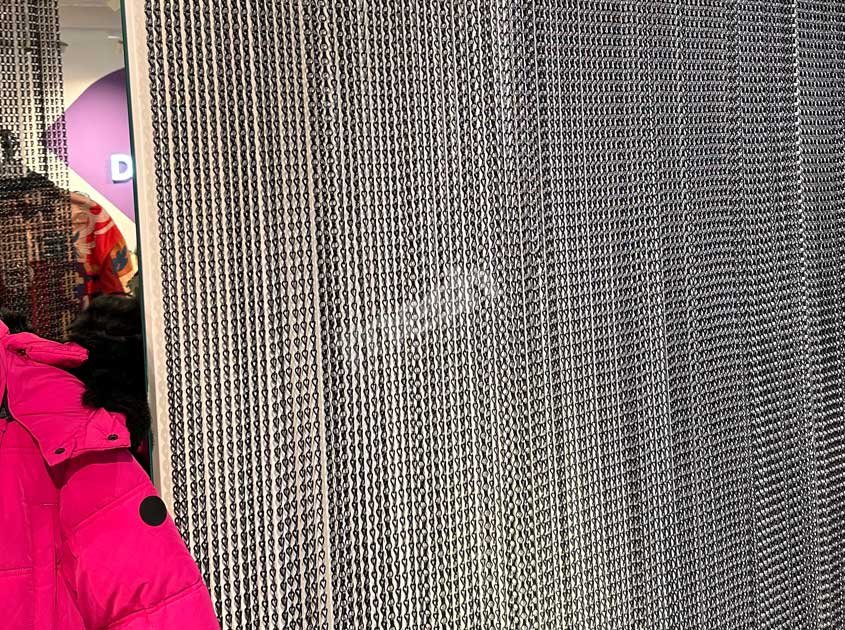
1. Rethinking Space: Separation Without Visual Isolation
One of the most useful characteristics of an aluminum chain curtain is its ability to create a boundary without forming a completely solid wall.
In many modern interiors, different functional areas need to be distinguished while maintaining visual continuity. A restaurant may need to separate dining areas from circulation routes. A retail store may want to frame a product display without blocking the surrounding merchandise. A hotel lobby may require decorative zoning that preserves an open and welcoming atmosphere.
Aluminum chain curtains provide a flexible alternative to conventional partitions.
Depending on the chain density, lighting conditions, viewing angle, and distance from the curtain, the material can appear relatively transparent or create a more defined visual screen. It can also be drawn aside or arranged in overlapping sections when the design requires greater flexibility.
Typical applications include:
Separating restaurant seating areas without creating permanent walls
Defining reception zones in hotels and offices
Creating semi-transparent backgrounds for retail displays
Framing entrances, corridors, and transition spaces
Dividing multipurpose interiors while maintaining an open visual connection
The design objective is not necessarily to hide one area from another. Instead, it is to establish a visual boundary that allows the overall interior to remain connected.
2. Designing With Light, Reflection, and Shadow
Light is one of the most important factors in the appearance of an aluminum chain curtain.
The inpidual metal links reflect light at different angles. As the viewing position or lighting direction changes, the curtain may appear brighter, darker, more textured, or more visually prominent. This creates a surface that can change throughout the day rather than remaining visually static.
In hospitality and retail projects, this interaction between metal and light can become part of the interior design concept.
Natural light
When positioned near windows or glazed facades, a chain curtain can introduce a metallic layer between the interior and the outside environment. Depending on its density and arrangement, it may soften the visual transition between areas while allowing portions of the surrounding environment to remain visible.
However, aluminum chain curtains should not automatically be treated as solar-shading systems. Their shading performance depends on the opening ratio, installation position, orientation, and actual lighting conditions.
Artificial lighting
In restaurants, bars, hotels, and exhibition spaces, directional lighting can emphasize the texture of inpidual links. Warm lighting may create a softer, more intimate atmosphere, while cooler lighting can reinforce a contemporary industrial or minimalist aesthetic.
Designers can experiment with:
Directional spotlights that highlight the chain texture
Backlighting that emphasizes the curtain's outline and openings
Grazing light that reveals surface details
Contrasting light and dark finishes for stronger visual definition
The key is to test the actual chain sample under the intended lighting conditions. Product photographs alone may not accurately represent reflectivity, color, or the visual density of the finished installation.
3. Creating Movement in Otherwise Static Interiors
Most architectural surfaces are fixed and visually stable. Aluminum chain curtains introduce a different quality: controlled movement.
When people walk past an installation or when air movement affects the hanging links, the curtain may sway gently and produce changing reflections. This can make a space feel more dynamic without requiring moving mechanical elements.
The effect is especially useful in environments where the interior needs a memorable visual feature.
In hotels, a chain curtain can form a decorative background behind a reception desk or create a transition between a lobby and a lounge.
In restaurants and bars, it can frame a private dining area or add depth behind a counter.
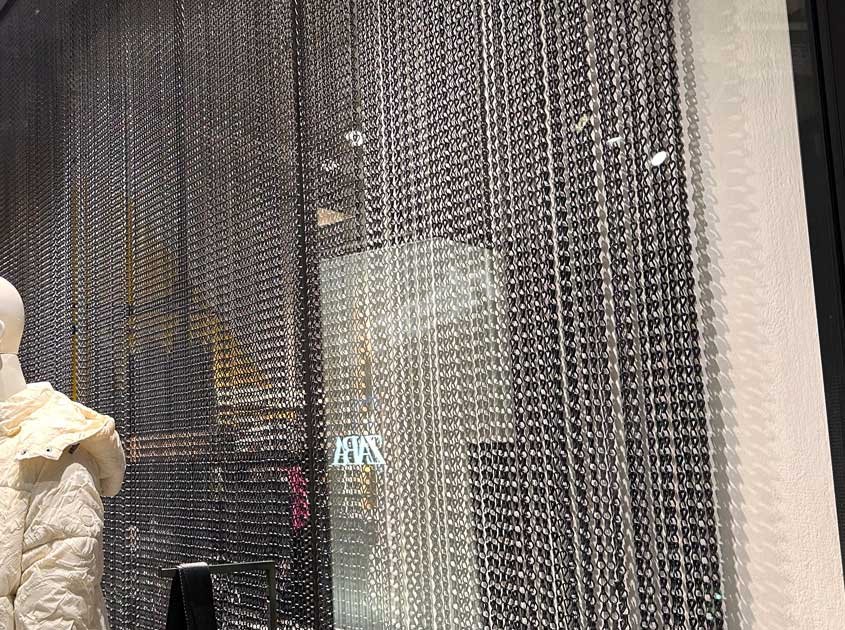
In retail spaces, it can create a distinctive backdrop for product displays, window presentations, or branded environments.
In exhibition spaces, it can help distinguish display zones while allowing visitors to retain a visual connection with surrounding exhibits.
Movement should nevertheless be considered carefully. In areas with strong air currents or frequent physical contact, designers should evaluate the hanging system, link arrangement, clearances, and expected maintenance requirements before finalizing the installation.
4. Choosing the Right Aluminum Chain Curtain for the Design Concept
A successful installation depends on more than selecting a color. Several product characteristics determine how the curtain looks and performs.
Chain style and visual texture
Different chain configurations can produce different visual effects. Smaller links may create a finer, more uniform texture, while larger links can produce a bolder pattern with a more noticeable open structure.
The correct choice depends on the viewing distance and the role of the curtain.
For a large hotel lobby, a finer texture may provide a sophisticated background without overwhelming the architecture. For a retail feature wall or a decorative entrance, a more pronounced chain pattern may create a stronger focal point.
Density and opening ratio
The spacing and arrangement of the links influence visual openness, light transmission, and the degree of separation between areas.
A relatively open configuration may be suitable where visibility and visual connection are priorities. A denser configuration may create a stronger decorative screen, although it still should not be assumed to provide privacy or acoustic insulation comparable to a solid partition.
When comparing samples, designers should evaluate the actual opening pattern rather than relying on product names such as "dense" or "lightweight."
Color and surface finish
Aluminum chain curtains are available in different colors and finishes, depending on the manufacturer's product range and finishing capabilities.
Common design directions include:
Silver or natural metallic tones for contemporary interiors
Black finishes for contrast and industrial-inspired spaces
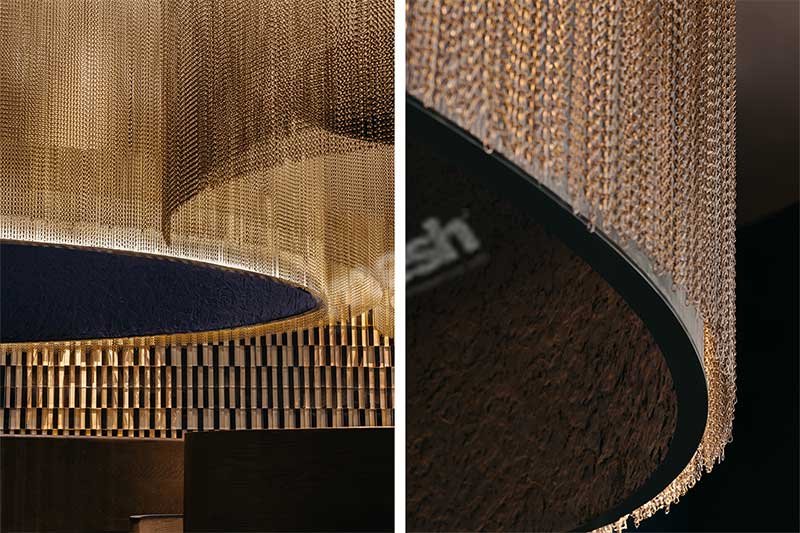
Gold or bronze tones for hospitality and luxury retail environments
Custom colors coordinated with furniture, lighting, and architectural finishes
Color consistency matters in large projects. Before approving production, request a representative sample and confirm the finish, color reference, acceptable variation, and whether the same finish can be maintained across all required batches.
Dimensions and installation configuration
The overall width and height of a chain curtain affect both its appearance and installation method.
A full-height installation may create a dramatic vertical element, while a shorter curtain can frame a counter, doorway, or display. Wider installations may require multiple curtain sections, depending on the product design and support system.
The final specification should identify the finished opening dimensions, curtain dimensions, mounting arrangement, and any required allowance for movement or clearance.
5. Matching Aluminum Chain Curtains to Different Interior Styles
Aluminum chain curtains are versatile, but the best results come from matching the product to the design intention.
Minimalist interiors
In minimalist spaces, a silver or neutral metallic finish can introduce texture without relying on elaborate patterns. A simple, continuous curtain may work particularly well against concrete, glass, stone, or plain architectural surfaces.
Industrial-style interiors
Black or dark metallic finishes can complement exposed structural elements, concrete walls, and metal furniture. The chain structure reinforces the material language of the space while remaining visually lighter than a solid metal partition.
Luxury hospitality interiors
Gold, bronze, or other coordinated finishes can introduce a decorative metallic accent in hotel lounges, bars, restaurants, and reception areas. Careful lighting and restrained use of reflective surfaces help prevent the installation from competing with other focal points.
Retail and exhibition environments
In retail stores and exhibition spaces, chain curtains can act as flexible display backgrounds. Their changing reflections may draw attention to products, while the open structure helps preserve sightlines.
For projects with prominent brand colors or a defined interior palette, it is advisable to review physical samples alongside the actual flooring, wall finishes, lighting, and furniture materials.
6. Aluminum Chain Curtains vs. Conventional Interior Dividers
Choosing an aluminum chain curtain is not always the right decision. The material is most effective when its specific characteristics match the project's requirements.
Design requirement
Aluminum chain curtain
Solid partition
Fabric curtain
Visual separation
Adjustable through configuration and density
Strong, usually opaque
Depends on fabric opacity
Visual openness
Generally retains some sightlines
Usually limited
Depends on fabric
Light interaction
Reflective metal texture
Depends on surface finish
Depends on fabric and color
Movement
Flexible hanging links can sway
Fixed
Fabric may sway or fold
Space flexibility
Can be designed for movable or fixed arrangements
Often requires structural changes to alter
Often easy to draw aside
Acoustic performance
Not a substitute for an acoustic barrier
Can be designed for acoustic performance
Specialized fabrics may offer some absorption
Maintenance
Depends on finish, environment, and installation
Depends on partition material
Depends on fabric type
This comparison highlights an important point: aluminum chain curtains are primarily a decorative and spatial-design solution. They should not be selected as a replacement for fire-rated partitions, secure barriers, or acoustic systems unless the complete proposed system has been specifically tested and approved for that purpose.
7. Installation Details That Shape the Final Result
Even a well-selected chain curtain can look disappointing if the mounting details are poorly planned.
Before production, the project team should confirm the following.
Support structure: The ceiling, beam, track, or other supporting element must be suitable for the installed load. For larger installations, confirm the total curtain weight and the load capacity of the complete support system.
Mounting method: Decide whether the curtain will hang from a fixed rail, a track system, or another compatible mounting arrangement. A movable curtain requires suitable hardware and sufficient clearance.
Finished dimensions: Confirm the actual opening size and how the curtain should meet adjacent walls, floors, ceilings, or architectural features. Do not rely solely on rough site measurements.
Edge and bottom conditions: Determine whether the curtain should hang freely, terminate above the floor, or follow a specific architectural line. Consider movement, cleaning access, and possible interference with nearby furniture or circulation routes.
Connection and finish consistency: For large projects, verify that the links, connection details, color, and surface finish are consistent across sections.
Sample approval: Approve a representative sample before ordering the full quantity. If appearance is critical, inspect it under the project's intended lighting conditions.
8. Maintenance and Long-Term Appearance
Aluminum chain curtains generally require straightforward routine care, but their maintenance needs depend on the finish, surrounding environment, and frequency of contact.
Dust and fingerprints may become noticeable in brightly lit areas or on highly reflective finishes. In restaurants and commercial interiors, airborne grease or cleaning residues may also accumulate over time.
A practical maintenance plan should include:
Periodic inspection for dust, surface contamination, and damaged links
Cleaning according to the manufacturer's guidance for the specific finish
Avoiding abrasive materials or unapproved chemicals that may damage the surface
Checking mounting hardware and connections, particularly in high-traffic areas
Inspecting for unusual movement, snagging, or interference with adjacent fixtures
For coastal, humid, or chemically demanding environments, confirm that the proposed aluminum material and surface treatment are appropriate for the exposure conditions. A decorative finish should not be assumed to provide unlimited corrosion resistance.
9. A Practical Specification Checklist for Interior Design Projects
Before requesting a quotation, architects, designers, contractors, and purchasing teams should prepare a clear product brief.
Include the following information:
Project type: Hotel, restaurant, retail store, office, exhibition, or residential interior.
Design objective: Decorative backdrop, space pider, entrance feature, display screen, or another specific purpose.
Curtain dimensions: Required width, height, number of sections, and finished opening dimensions.
Product configuration: Chain style, link size, density, and any relevant opening specifications.
Material and finish: Aluminum specification, color, surface treatment, and sample approval requirements.
Mounting system: Fixed or movable arrangement, support details, and installation constraints.
Environmental conditions: Indoor exposure, humidity, cleaning requirements, and expected physical contact.
Project quantity: Number of curtains, inpidual dimensions, and any variations between areas.
Documentation: Drawings, sample requirements, packing details, and installation guidance.
For international projects, it is also useful to confirm production lead time, packaging method, shipment dimensions, and whether the supplier can provide consistent finishes across repeat orders.
A complete specification helps suppliers quote the intended product rather than an approximate alternative, reducing the risk of unexpected differences during installation.
Frequently Asked Questions
Are aluminum chain curtains suitable for commercial interiors?
Yes. They can be used in hotels, restaurants, retail stores, offices, exhibition spaces, and other commercial interiors when their appearance, mounting method, and maintenance requirements suit the project.
Do aluminum chain curtains provide privacy?
They provide visual separation rather than complete privacy. The actual degree of visibility depends on chain density, viewing angle, lighting, and distance. A denser configuration may reduce direct visibility but should not be treated as an opaque privacy barrier.
Can aluminum chain curtains be customized?
Customization may include dimensions, chain configuration, color, finish, and mounting arrangement, depending on the manufacturer's capabilities. Confirm available options and sample approval procedures before ordering.
Are aluminum chain curtains suitable for outdoor use?
Some products may be suitable for selected exterior applications, but suitability depends on the aluminum specification, surface treatment, weather exposure, wind conditions, and mounting design. Confirm the intended exposure with the manufacturer before specifying an outdoor installation.
How should designers choose between aluminum and stainless steel chain curtains?
Aluminum is often considered when a lightweight decorative metal curtain is preferred. Stainless steel may be more appropriate when the project requires particular mechanical properties or a different material appearance. The decision should account for the complete product specification, finish, installation load, environmental exposure, and budget.
Conclusion: Treat the Chain Curtain as Part of the Architecture
Aluminum chain curtains can do more than decorate a doorway or pide a room. When carefully specified, they become part of the interior's visual structure—shaping sightlines, interacting with light, introducing movement, and helping different areas feel connected without appearing identical.
The strongest designs begin with a clear question: what should the curtain do for the space? Once that purpose is defined, designers can select the chain configuration, density, finish, dimensions, and mounting method to support the intended result.
For architects, interior designers, contractors, and project buyers, the goal is to balance visual effect with practical installation and maintenance requirements. A well-planned aluminum chain curtain can then contribute to a distinctive interior that feels both functional and contemporary.
next:none
© 2026 Joinwin Architectural Wire. All Rights Reserved. | Sitemap

Recommended Read
How to Select the Right Metal for Architectural Mesh: Stainless Steel, Aluminum and Carbon Steel Compared
How Aluminum Chain Curtains Create Modern Interior Spaces
Aluminum Chain Curtain for Commercial Spaces: Restaurant, Hotel and Retail Design Ideas