Modern interior design is not only about choosing attractive furniture, colors, and finishes. It is also about controlling how people move through a space, how natural light travels, and how different areas connect visually.
An aluminum chain curtain offers a distinctive way to achieve these goals. Made from interconnected aluminum links, it creates a flexible screen that can separate areas without completely closing them off. Its metallic surface reflects light, its open structure maintains visual connections, and its movement introduces a subtle sense of motion into an otherwise static interior.
From hotel lobbies and restaurant interiors to retail displays and contemporary offices, aluminum chain curtains give designers another way to balance openness, privacy, decoration, and functionality.
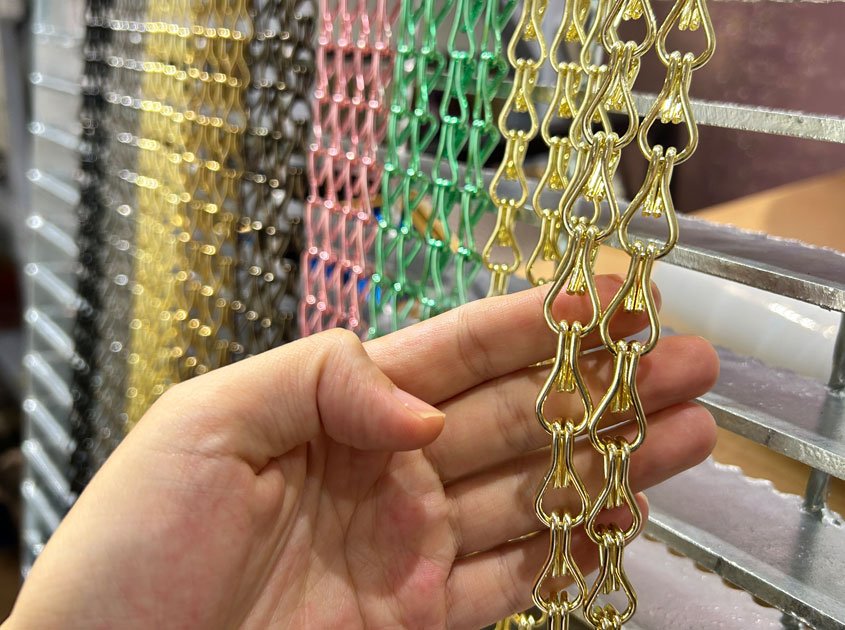
1. What Makes Aluminum Chain Curtains Suitable for Modern Interiors?
Traditional partitions create clear physical boundaries. Solid walls provide separation but block views, while glass partitions maintain visibility but can feel rigid and may require additional privacy treatments.
Aluminum chain curtains offer a different approach. They create a visual boundary without forming a completely solid surface.
Their design value comes from several characteristics.
Visual separation without a closed-off feeling
An aluminum chain curtain can distinguish a dining area from a walkway, pide a retail display from the main shopping area, or separate a lounge from a reception space.
Because the curtain consists of inpidual metal links rather than a solid panel, people can often see through it. The degree of visibility depends on the link design, hanging density, viewing angle, and lighting conditions.
This makes chain curtains useful in interiors where designers want to define zones while preserving a sense of openness.
A distinctive metallic texture
Aluminum chain curtains introduce a different visual texture from fabric, wood, glass, or conventional metal panels.
Depending on the finish and color, the curtain can complement minimalist interiors, industrial-style spaces, contemporary retail environments, and more decorative hospitality projects.
Flexibility in design
Chain curtains can be manufactured in different dimensions, colors, and hanging configurations. Designers can use them across a full opening, as a partial screen, behind a reception desk, or as a decorative feature suspended from a ceiling-mounted track.
The result is a design element that can serve both an architectural and a decorative purpose.
2. Five Ways Aluminum Chain Curtains Transform Interior Spaces
2.1 Create Open-Plan Zones Without Building Walls
Open-plan layouts are common in restaurants, hotels, retail stores, and shared commercial spaces. However, an entirely open layout can make different functions difficult to distinguish.
Aluminum chain curtains help introduce visual organization without permanently piding the floor plan.
For example, a restaurant can use a chain curtain to distinguish a private dining area from the main seating area. A hotel lounge can create a subtle boundary between a waiting area and a quieter seating zone. In an office, a decorative chain screen may help define a reception or collaborative area.
Unlike a fixed wall, a chain curtain can sometimes be pulled aside, removed, or reconfigured, depending on the support system and installation design.
Design tip: Use chain curtains where visual zoning matters more than complete sound isolation. They are not a substitute for an acoustic partition when substantial noise reduction is required.
2.2 Turn Light into a Decorative Feature
Light can dramatically change the appearance of a metallic surface.
When natural or artificial light reaches an aluminum chain curtain, inpidual links create small highlights and shadows. As the viewer moves, the appearance of the curtain changes with the viewing angle.
Designers can use this effect to add visual depth to otherwise plain interiors.
Consider three common approaches:
Natural daylight: Position a chain curtain near a window or glazed entrance to create a changing pattern of highlights throughout the day.
Directional lighting: Use carefully positioned spotlights to emphasize the metallic texture and create depth on the curtain surface.
Backlighting: Place lighting behind or near the screen to create a layered visual effect, taking account of the curtain's openness and the brightness of the background.
The final appearance depends on the aluminum finish, link structure, lighting direction, and surrounding materials. A polished finish may produce stronger highlights, while a matte or brushed finish can create a more restrained look.
Lighting should be tested with a sample whenever the visual effect is central to the project.
2.3 Add Movement to Static Interiors
Most architectural finishes remain visually unchanged as people move through a room. An aluminum chain curtain introduces a different experience.
Inpidual links can move gently when disturbed by air movement or people passing nearby. This movement creates a changing relationship between the curtain, lighting, and background.
Designers can use this quality in hotel entrances, restaurant transitions, retail feature walls, exhibition spaces, and other interiors where visual interest is important.
Movement should remain appropriate for the setting. In busy circulation areas, the curtain needs suitable clearance and secure installation to reduce snagging or unwanted contact.
2.4 Introduce Metallic Color Without Heavy Materials
Aluminum chain curtains are available in different finish and color options, depending on the manufacturer's process and product range.
Silver-toned finishes can complement glass, concrete, and cool neutral palettes. Gold or bronze tones can introduce warmth into hospitality interiors. Black and darker finishes can create contrast in retail displays, contemporary bars, and industrial-inspired spaces.
The key is to treat the curtain as part of the overall material palette rather than as an isolated decoration.
For example:
Interior style
Possible chain curtain finish
Design objective
Minimalist
Silver or natural aluminum tone
Maintain a clean, restrained appearance
Luxury hospitality
Gold or bronze tone
Add warmth and visual emphasis
Industrial
Dark or metallic finish
Complement concrete, steel, and exposed structures
Contemporary retail
Silver, black, or a selected color
Support the brand's visual identity
Exhibition or event space
Project-specific color
Create a recognizable feature or backdrop
Actual color availability, consistency, and surface appearance should be confirmed with product samples. Different finishing processes can produce different results, even when the color names are similar.
2.5 Create Depth in Small or Narrow Spaces
In a narrow corridor, compact shop, or small hospitality interior, a solid partition may make the space feel more enclosed.
A suitably open chain curtain can establish a visual boundary while allowing parts of the background to remain visible. This layered effect can make the interior feel more visually complex without adding a bulky structure.
Designers can also place chain curtains in front of wall finishes, display shelving, or selected lighting elements to create depth.
However, a chain curtain does not automatically make a room feel larger. A dense arrangement, dark finish, or poorly positioned screen may make the space feel heavier. The opening size, curtain width, lighting, and background all influence the result.
3. Where Can Aluminum Chain Curtains Be Used?
Different commercial environments have different design requirements. The best application depends on the balance between appearance, visibility, access, maintenance, and installation.
Restaurants, cafés, and bars
Aluminum chain curtains can distinguish dining zones, frame a bar area, decorate an entrance, or create a backdrop for a feature wall.
They are particularly useful when a restaurant wants to create separate visual zones without making the layout feel completely enclosed.
For kitchens, food preparation areas, and other hygiene-sensitive locations, the product's cleaning requirements and local regulations should be reviewed before specifying it.
Hotels and hospitality spaces
In hotels, chain curtains can be used around lounge areas, reception features, event spaces, and selected decorative openings.
A metallic screen can help establish a transition between public areas while contributing to the interior's overall material palette.
For high-traffic locations, the design should account for secure overhead support, accessibility, cleaning access, and possible contact with guests or luggage.
Retail stores and shopping environments
Retail designers can use chain curtains to frame product displays, create a branded backdrop, distinguish departments, or add texture to storefront interiors.
Because the links allow partial visibility, a display can remain visually connected to the surrounding store while gaining a distinct boundary.
For projects that require precise brand colors, confirm the finish through a physical sample and establish approval requirements before production.
Offices and commercial interiors
In offices and shared commercial spaces, aluminum chain curtains can serve as decorative screens for reception zones, meeting-area entrances, and selected collaborative spaces.
They are most suitable when the priority is visual definition rather than privacy, sound control, or security.
Where confidential conversations or visual privacy are essential, a more enclosed partition or a combined screening solution may be necessary.
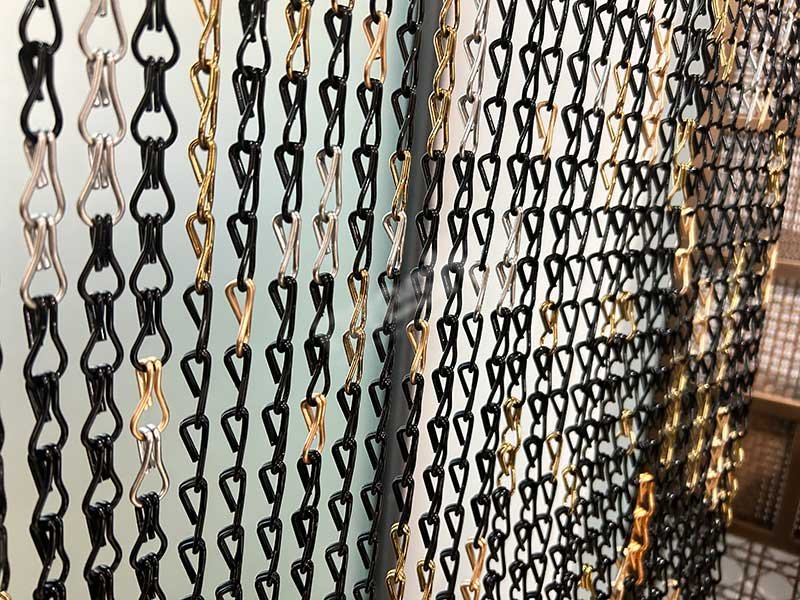
4. How to Choose the Right Aluminum Chain Curtain for an Interior Project
A successful design depends on more than choosing a color. The product configuration needs to match the intended visual effect and installation conditions.
Step 1: Define the main purpose
Start by identifying the primary role of the curtain.
Room pider: Prioritize the desired balance between visibility and visual separation.
Decorative backdrop: Focus on finish, lighting, texture, and the relationship with the background.
Entrance feature: Consider movement, clearance, traffic flow, and the mounting arrangement.
Retail display screen: Balance product visibility with the level of separation required.
Ceiling-hung decorative element: Confirm the suspension system, total weight, and supporting structure.
A clear design objective helps prevent unnecessary customization.
Step 2: Select the chain structure and hanging density
The chain structure influences how the curtain looks and functions.
A more open arrangement generally allows greater visibility through the screen. A denser arrangement creates a more visually continuous surface, although it still does not provide the same privacy as an opaque panel.
When comparing samples, assess:
Link dimensions and shape
Spacing and overall hanging density
Visual coverage from typical viewing distances
Curtain weight per unit area
How the links hang and move
Whether the arrangement suits the intended opening
Ask the supplier to confirm the actual product configuration rather than relying on the description "open" or "dense" alone.
Step 3: Choose the finish and color
The finish affects how the chain curtain interacts with lighting and surrounding materials.
Consider the colors of nearby metalwork, wall finishes, flooring, furniture, and lighting fixtures. In commercial projects, request samples where color matching is important.
Also confirm the available finishing options, cleaning recommendations, and any project-specific requirements for finish durability.
Step 4: Confirm dimensions and installation details
Accurate measurements are essential for a clean installation.
Confirm the opening width and height, required curtain coverage, track or frame dimensions, and whether the curtain should hang to the floor or stop above it.
For large or ceiling-suspended installations, the supporting structure must be suitable for the curtain's total weight and the loads created by its intended use. Mounting hardware should be selected for the actual installation conditions.
Do not assume that all chain curtains can be installed using the same track, hooks, or fixing system.
Step 5: Review samples before bulk production
A small sample can reveal details that are difficult to judge from a photograph.
Check the link appearance, color, finish, visual density, movement, and compatibility with the surrounding materials. For large projects, a sample panel or mock-up can help the design team assess the overall effect under actual lighting conditions.
5. Aluminum Chain Curtain vs. Traditional Interior Materials
Aluminum chain curtains are not intended to replace every type of partition or decorative finish. Their value becomes clearer when compared with other options.
Material
Main design characteristic
Important consideration
Aluminum chain curtain
Metallic texture, partial visibility, potential for movement
Limited sound and visual privacy
Fabric curtain
Soft appearance, flexible color and texture choices
Cleaning and wear depend on fabric type
Glass partition
Clear visual connection and a more defined boundary
May require privacy treatment and suitable hardware
Solid wall or panel
Strong physical separation and design continuity
Reduces openness and requires more substantial construction
Perforated metal panel
Structured pattern and consistent panel geometry
Generally less flexible in movement than a chain curtain
The right material depends on the design objective. If the project requires a lightweight visual screen with a distinctive metallic appearance, an aluminum chain curtain may be worth considering. If acoustic separation, complete privacy, or a rigid barrier is the priority, another system may be more appropriate.
6. Common Design and Purchasing Mistakes to Avoid
Even a well-designed chain curtain can disappoint when product details are not confirmed early enough.
Choosing from photographs alone. Online images may not accurately represent color, link density, reflectivity, or scale. Review physical samples for important projects.
Ignoring the supporting structure. A decorative curtain still has weight. Confirm the total load, fixing method, track capacity, and suitability of the ceiling or frame.
Expecting complete privacy. Visibility depends on link structure, lighting, and viewing angle. A chain curtain should not be specified as an opaque privacy screen.
Using the same configuration for every space. A restaurant pider, retail backdrop, and hotel feature wall may need different dimensions, density, finishes, and mounting arrangements.
Overlooking cleaning and maintenance. Dust can accumulate between links. Establish a practical cleaning method and ensure that installed sections remain accessible.
Failing to approve the final finish. For multi-area or phased projects, document the approved sample and confirm the expected finish consistency before placing the full order.
7. What Information Should You Provide When Ordering Custom Aluminum Chain Curtains?
For architects, interior designers, contractors, and project buyers, a clear inquiry helps suppliers recommend a suitable configuration and prepare a more accurate quotation.
Specification
Information to provide
Application
Restaurant, hotel, retail, office, exhibition, or other use
Installation location
Doorway, room pider, wall feature, ceiling, or display
Dimensions
Width, height, quantity, and number of sections
Chain configuration
Preferred link type, size, and hanging density, if known
Finish and color
Standard option, reference sample, or project color requirement
Mounting method
Track, frame, hooks, or another proposed system
Project drawings
Opening details, installation sketches, or architectural drawings
Quantity
Number of curtains, total area, or project quantities
Delivery requirements
Destination country, required delivery schedule, and packaging needs
If the exact chain configuration has not yet been selected, provide the intended application, photographs, opening dimensions, and design references first. A supplier can then help narrow down the available options.
For larger commercial projects, it is also useful to request a sample, confirm the installation details, and agree on the finish before production begins.
Frequently Asked Questions
Are aluminum chain curtains suitable for modern interior design?
Yes. Their metallic texture, partial visibility, and flexible design options make them suitable for many contemporary commercial interiors, including restaurants, hotels, retail stores, reception areas, and exhibition spaces.
Do aluminum chain curtains provide privacy?
They provide visual screening rather than complete privacy. The amount of visibility depends on the chain structure, hanging density, lighting, and viewing angle. For confidential or private spaces, consider a more enclosed partition.
Can aluminum chain curtains be customized?
Many manufacturers offer options for dimensions, colors, finishes, and hanging configurations. Available choices depend on the specific product range and production process, so confirm the details before ordering.
Are aluminum chain curtains suitable for restaurants and hotels?
They can be used for decorative room piders, feature walls, entrances, and selected lounge or display areas. The installation should account for traffic flow, cleaning access, secure mounting, and the requirements of the intended location.
How do you clean an aluminum chain curtain?
Cleaning methods depend on the finish and product construction. Regular dust removal and appropriate gentle cleaning may be suitable, but the manufacturer's instructions should be followed. Avoid assuming that every finish can tolerate the same chemicals or cleaning equipment.
What should architects consider before specifying an aluminum chain curtain?
Key considerations include visual openness, chain dimensions, hanging density, finish, color, total weight, lighting, opening dimensions, fixing details, maintenance access, and the required level of privacy. A physical sample or project mock-up can help confirm the final appearance.
Conclusion: A Flexible Design Element for Contemporary Interiors
An aluminum chain curtain can do more than decorate an opening. It can organize an open-plan interior, create a layered visual effect, interact with natural and artificial light, and introduce metallic texture without relying on a solid partition.
Its success depends on matching the chain structure, finish, density, dimensions, and installation method to the project's purpose.
For architects, interior designers, contractors, and commercial project buyers, the most effective approach is to begin with the intended spatial effect, review material samples, and confirm the technical details before production.
Looking for aluminum chain curtains for a commercial interior project? Share your application, dimensions, preferred finish, and project requirements with a manufacturer to explore a suitable custom solution.
pre:Aluminum Chain Curtain for Commercial Spaces: Restaurant, Hotel and Retail Design Ideas
next:none
© 2026 Joinwin Architectural Wire. All Rights Reserved. | Sitemap

Recommended Read
Aluminum Chain Curtain for Commercial Spaces: Restaurant, Hotel and Retail Design Ideas
Aluminum Chain Curtain vs Traditional Fabric Curtain: Differences, Applications and Buying Guide
How to Choose the Right Aluminum Chain Curtain for Interior Design?